🧬 GUIDELINE-BASED
Guideline-informed estimates.
Informed by WHO and ACSM hydration guidelines. Accounts for weight, age, gender, activity level, climate, and exercise duration to produce a personalized daily hydration estimate.
Our free water intake calculator provides a personalized daily hydration estimate based on your weight, age, gender, activity level, and climate — in liters, ounces, and cups. Get a full hydration schedule, not just a number.
Based on WHO & ACSM hydration guidelines · No personal data stored · Works offline
5 vars
Weight, age, gender, activity, climate
4 units
Liters, mL, fl oz, and cups
8 slots
Personalized daily schedule
100%
Free — no account required
WATER INTAKE CALCULATOR
Enter your details below. Our hydration calculator uses a guideline-informed formula to estimate your daily hydration needs — adjusted for activity, climate, and exercise.
STEP 01
Gender
Activity Level
Climate / Temperature
Enter your details
Your personalized hydration result will appear here.
HOW IT WORKS
01
Enter your body weight in kilograms or pounds and your age. These two inputs determine your baseline daily water requirement.
02
Choose male, female, or other (gender affects the base multiplier), and select your typical activity level — from sedentary to very active.
03
Select the climate zone where you live or work (temperate to very hot), then drag the exercise slider to your average daily workout time.
The advice to drink 8 glasses daily has no specific scientific basis. Your body is unique, so using a personalized water intake estimator helps you set a realistic hydration goal. It works as an advanced daily water intake estimator, making it simple to estimate water intake that may support your digestion, skin health, and energy levels.
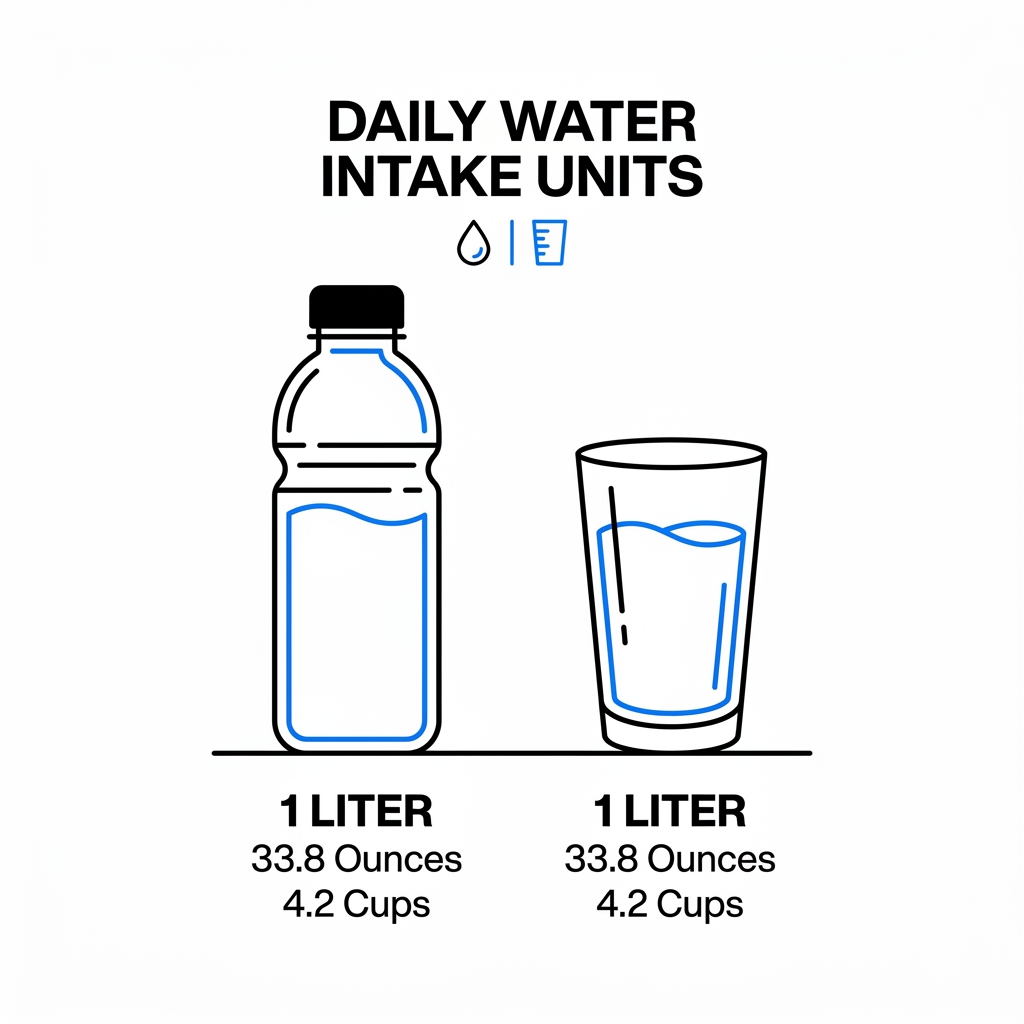
Our water intake calculator by weight uses the formula Weight (kg) × 33ml for men and Weight (kg) × 31ml for women. To fit different container sizes and tracking habits, the tool functions as a water intake calculator liters output, a water intake calculator ounces reader, and a water intake calculator cups tracker simultaneously.
The Institute of Medicine (IOM) sets an adequate intake of 3.7 L/day for men and 2.7 L/day for women in total fluids from all sources. The World Health Organization and ACSM both suggest adjusting fluid intake upward for exercise and heat exposure. Our water consumption calculator applies these general adjustments as estimates.
People who actively track their daily water intake drink 20% more on average. Knowing your personal target — not just a generic number — is the first step. Use our hydration tracker below to log every glass and build the habit with streak motivation.
FEATURES
A complete free hydration platform — personalized, trackable, and available in liters, ounces, and cups.
Informed by WHO and ACSM hydration guidelines. Accounts for weight, age, gender, activity level, climate, and exercise duration to produce a personalized daily hydration estimate.
Not just a number — a full 8-slot plan from 7am to 10pm so you know exactly when to drink your recommended daily water intake throughout the day.
Hot weather may increase your water consumption needs. Some guidelines suggest up to +35% in very hot conditions. Our calculator adjusts estimates based on your climate zone.
Adds approximately 500ml per 30 minutes of exercise — based on ACSM hydration guidelines as a general starting point for active individuals.
Log every glass and build hydration streaks. Your daily water intake data is saved locally — no account needed. Works as a full-featured hydration tracker.
Convert between liters, milliliters, fluid ounces, cups, and gallons instantly. Use our water intake calculator in liters or ounces — whichever unit you prefer.
Whether you need a dedicated water intake calculator for men with adjusted baseline factors, a tailored water intake calculator for women that includes baseline adjustments (such as during pregnancy or breastfeeding), or an adaptive water intake calculator by age for older adults whose hydration needs change, our platform provides a personalized hydration estimate tailored to your profile.
HYDRATION TRACKER
Log every glass and hit your personalized recommended daily water intake goal. Data stays on your device — no account, no cloud required.
Loading tracker…
SMART RECOMMENDATIONS
Evidence-based advice for morning hydration, exercise, hot weather, and water intake for weight loss.
Drinking ~500ml of water after waking may help rehydrate after 6–9 hours without fluids. Some research suggests morning hydration can support energy levels and may help reduce appetite at breakfast.
Drink 400–600ml 2 hours before exercise. During your workout, consume 150–350ml every 20 minutes. After exercise, drink 1.5× the fluid lost through sweat. Our water intake calculator during exercise adds this automatically.
In temperatures above 30°C (86°F), increase your daily water intake by 20–35%. Add electrolytes for workouts exceeding 60 minutes in heat. Light-yellow urine is your best real-time hydration indicator.
Some studies suggest drinking ~500ml before meals may help reduce calorie intake. Research also indicates water may temporarily support metabolic rate. Our calculator provides a hydration estimate to support your overall wellness goals.
UNIT CONVERTER
Need your result in a different format? Convert between liters, milliliters, fluid ounces, cups, and gallons. Whether you prefer the water intake calculator in liters, ounces, or cups — we have you covered.
2 L = 67.6 oz
Common reference values
SPECIALIZED CALCULATORS
Calculate your exact daily water requirement with a full 8-slot schedule.
Weight-based formula — 33ml per kg — with instant results in liters, ounces, and cups.
Calculate the optimal daily water intake to support your weight loss goals.
Male-specific hydration baseline: gender-adjusted formula for accurate daily requirements.
Female-specific calculation with notes for pregnancy and breastfeeding.
Age-adjusted recommendations for children, adults, and seniors.
Hydration assessment tool including general dehydration indicators and a wellness score.
ACSM-based before, during, and after exercise hydration protocol.
Science-based guide with the urine colour test and daily targets by body weight.
HYDRATION MYTHS VS FACTS
Much of what people believe about hydration isn't supported by evidence. Here are three of the most widespread misconceptions.
No specific scientific basis. A 2002 review in the American Journal of Physiology found no evidence supporting this universal rule. Your needs depend on weight, activity, and climate.
FACT: Largely a mythResearch suggests moderate coffee intake (up to ~400mg caffeine/day) does not cause net dehydration in habitual consumers. The water in coffee outweighs the mild diuretic effect.
FACT: Mostly falseColourless urine may occasionally indicate overhydration. Pale straw-yellow is generally considered optimal. Very dark yellow may suggest drinking more.
FACT: OversimplificationIMPORTANT BALANCE
Yes — in certain circumstances. Drinking very large amounts of water, particularly without electrolyte replacement during prolonged exercise, can lead to a serious condition called hyponatremia (low blood sodium).
For most healthy adults following general hydration guidance, overhydration from ordinary daily drinking is uncommon. But endurance athletes, people with certain medical conditions, and those following extreme water protocols should be aware of the risk.
Learn about overhydration →⚕️ Seek emergency care for severe symptoms. This is educational only.
PRACTICAL GUIDANCE
Practical, evidence-informed habits to help you stay consistently hydrated throughout the day.
A glass of water upon waking helps rehydrate after 6–8 hours without fluids. Some research suggests morning hydration may support alertness and appetite regulation at breakfast, though individual responses vary.
A water bottle with volume markings removes guesswork. Knowing your bottle holds 750ml makes it easy to track how many refills hit your daily target — no app or log required.
Cucumber (~96% water), watermelon (~91%), and lettuce (~95%) contribute meaningfully to daily fluid intake. The National Academies estimate that food provides approximately 20% of total daily water for most people.
Linking water intake to existing daily habits — before meals, with coffee, at the start of each work hour — is a practical strategy to build consistency without relying on thirst alone, particularly for older adults.
Hot weather and physical activity significantly increase fluid losses through sweat. General guidance suggests drinking more proactively during these conditions rather than waiting for thirst, which may lag behind fluid needs during intense activity.
Pale straw-yellow urine is a practical real-time hydration indicator. If you notice dark yellow urine consistently, it may be worth increasing fluid intake. Colourless urine may suggest drinking more than needed.
The hydration estimates provided by this calculator are informed by the following authoritative health organisations and published research. Individual needs vary — consult a healthcare professional for personalised advice.
HYDRATION GUIDES
FAQ
Common questions about daily water requirements, the hydration calculator formula, and how to use the tracker.
The calculator uses a weight-based formula as a starting point — approximately 33ml per kilogram of body weight per day for men and 31ml per kilogram for women, informed by general hydration guidance. It then applies adjustments for your activity level (sedentary to very active), climate conditions (up to approximately +35% in very hot environments), and adds around 500ml per 30 minutes of daily exercise, based on the American College of Sports Medicine's fluid replacement guidance. Results are shown in liters, milliliters, fluid ounces, and cups — along with a personalised 8-slot daily hydration schedule. All results are estimates. Individual needs vary and these figures are not a substitute for professional medical advice.
There is no single universal answer, as hydration needs depend on body size, age, activity, climate, diet, and health status. For context, the National Academies of Sciences sets an adequate intake of approximately 3.7 liters of total daily fluid for adult men and 2.7 liters for adult women — but this includes water from all sources including food, which typically contributes around 20% of total intake. The European Food Safety Authority (EFSA) recommends 2.5 liters per day for men and 2.0 liters for women from beverages alone. These are population-level benchmarks, not prescriptions for individuals. Our calculator uses these frameworks to generate a personalised starting estimate. If you have any health condition, consult a healthcare professional for guidance.
A commonly cited weight-based guideline is approximately 30–35ml per kilogram of body weight per day. For example, someone weighing 70kg might use this to estimate a baseline of roughly 2.1–2.5 liters per day before adjustments for activity or climate. Our calculator applies this approach automatically. This method provides a starting estimate — it does not account for medical conditions, medications, or other individual factors that affect hydration needs.
Yes. Consuming very large quantities of water in a short period — particularly without adequate electrolyte replacement — can lead to a condition called hyponatremia, sometimes called water intoxication. This occurs when sodium levels in the blood become dangerously diluted. It is most commonly reported in endurance athletes who consume large amounts of plain water during prolonged exercise. Symptoms can include nausea, headache, confusion, and in severe cases, seizures. For most healthy adults following general hydration guidance, overhydration is unlikely from ordinary drinking. However, people with certain medical conditions (including kidney disease or heart failure) may have specific fluid restrictions and should follow professional medical guidance rather than general calculators.
Research suggests that caffeinated beverages such as coffee and tea do contribute to daily fluid intake in most healthy adults. Despite their mild diuretic effect, studies indicate that the water content of these drinks more than offsets the fluid loss caused by caffeine — resulting in a net positive hydration contribution. A 2003 review in the Journal of Human Nutrition and Dietetics concluded that moderate coffee consumption does not result in dehydration. Other fluids including juice, milk, and herbal teas also count toward daily fluid totals. Plain water remains the most efficient, zero-calorie hydration source. Very high caffeine intake (above approximately 500mg per day) may increase fluid needs.
General hydration guidance suggests that adult men typically need more fluid than women, in part due to differences in average body size and muscle mass. The National Academies of Sciences sets an adequate intake benchmark of 3.7 liters total daily fluid for men (including water from food). The EFSA recommends 2.5 liters from beverages per day. Our calculator uses a weight-based formula of approximately 33ml per kilogram as a baseline and adjusts for your activity level and climate. These are estimates — individual needs vary, and anyone with a health condition should consult a qualified healthcare provider.
General hydration guidance suggests that adult women typically need somewhat less fluid than men on average, though individual needs vary significantly. The National Academies of Sciences sets an adequate intake of 2.7 liters total daily fluid for women. The EFSA recommends 2.0 liters from beverages per day. Fluid needs increase during pregnancy — general guidance suggests an additional 300ml or more per day — and increase further during breastfeeding, with some guidelines recommending approximately 700ml above baseline. Our calculator uses a baseline of approximately 31ml per kilogram of body weight and adjusts for your personal profile. These are estimates; people with medical conditions or those who are pregnant or breastfeeding should consult a healthcare professional.
Hydration needs change across the lifespan. Children generally need less total water than adults, with guidance suggesting around 1.1–1.3 liters per day for young children (ages 4–8) increasing through adolescence. Older adults (65+) face a particular challenge: the sense of thirst diminishes with age, meaning older people may not feel thirsty even when they are becoming dehydrated. Some research suggests older adults are at higher risk of dehydration than younger adults despite similar fluid needs. Our calculator applies age-based adjustments as part of its formula. Any concerns about hydration in older adults or children should be discussed with a healthcare professional.
Yes. Food contributes a meaningful proportion of daily fluid intake for most people. The National Academies of Sciences estimates that approximately 20% of daily water intake comes from food in typical Western diets. Water-rich foods such as cucumber (approximately 96% water), watermelon (approximately 91%), lettuce (approximately 95%), and celery (approximately 95%) contribute particularly well. Cooked grains, soups, and most fruits and vegetables also provide fluid. The adequacy intake benchmarks set by health organisations (such as 3.7 liters for men and 2.7 liters for women from the National Academies) include water from all sources. Our calculator estimates drinking water needs specifically, which is why its outputs may be lower than total fluid benchmarks.
Consistent tracking — rather than relying on thirst alone — is one practical approach to meeting hydration goals. Strategies that research and health guidance suggest may help include using a measured water bottle, setting scheduled drinking reminders tied to daily activities, and logging intake with a tracker. Our built-in hydration tracker allows you to log each glass, shows a daily progress ring, and tracks your streak — all stored locally on your device with no account required. Pairing our calculator's personalised target with the tracker provides a structured approach to building a hydration habit.
One commonly referenced real-time indicator is urine colour, though it can be affected by vitamins, certain medications, and foods. General guidance suggests that pale straw-yellow urine typically indicates adequate hydration; dark yellow or amber urine may suggest you should drink more; and colourless urine may occasionally indicate overhydration. Urinating approximately 4–7 times per day is often cited as a general sign of adequate intake in healthy adults. Persistent dark urine, dizziness, or fatigue may warrant professional evaluation, especially in older adults or those with health conditions.
This water intake calculator is for informational purposes only. For specific medical conditions, pregnancy, or concerns about your recommended daily water intake, please consult a qualified healthcare provider.
⚕️ Not medical advice. Sources: WHO, IOM, Mayo Clinic, ACSM. Medical disclaimer →